Put not your trust in rulers, nor in any child of earth,
Psalm 146:2-3 (Book of Common Prayer, p. 803)
for there is no help in them.
When they breathe their last, they return to earth,
and in that day their thoughts perish.
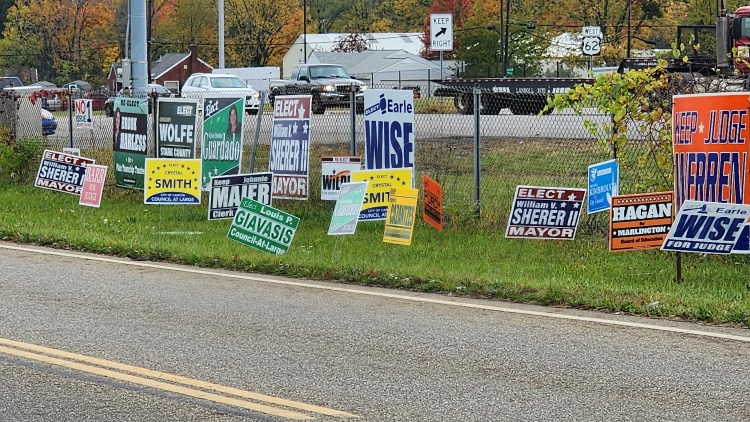
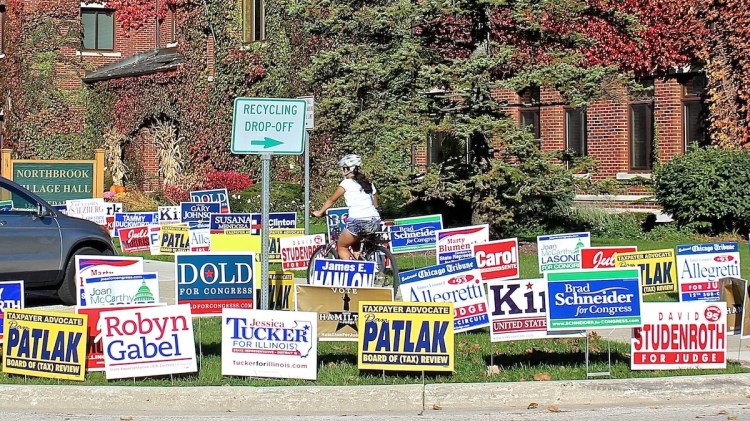
I will apologize at the outset if this post sounds like a rant; but each year, around the height of election season, my blood begins to boil at the sight of political yard signs.
I used to find it humorous, but the practice of voicing one’s opinion by way of a sign has gone from silly to absolutely ridiculous in some cases.
I happen to live in a development that doesn’t allow them, which lessens the tension among neighbors. But except for those kinds of housing restrictions, there is hardly a street that doesn’t have a sign or two. I’m always curious as to what the homeowner hopes to accomplish by posting the sign.
Three years ago, during the last presidential campaign, I also began to notice a proliferation of American flags, which are added either for emphasis, or perhaps as a warning that voting for the opponent is somehow unpatriotic.
Even more troubling, is the accusation that a vote for a certain candidate is in some way more or less faithful. Campaign ads are ferocious when it comes to attacking or supporting an issue, such as, for example, abortion, which is front and center in the state of Ohio.
As I drive through neighborhoods and see two opposing signs next door to each other, I ask myself, “I wonder if they go to the same church? How do they handle that difference there?”
Let me be clear, voting is a serious matter. The candidate who is ultimately elected will have the authority of that office, which can and will have substantial effects on the lives of the people who live in that municipality, county, or state. So it is in everyone’s best interests to examine the candidates’ backgrounds and qualifications to fill that position.
But elected officials are not divine. They are human. And as such, they have no magical or mystical powers to radically improve one’s situation. This is a belief that has carried over from the ancient world, where people regarded rulers as earthly representatives of the gods. In reality, many were far from that. They were ruthless despots.
The Israelites learned that lesson the hard way. When they asked for a king because they wanted to be like other nations, God warned the Israelites of the consequences, but they would not listen. (1 Samuel 8:1-22) Needless to say, Israel’s life under kings wasn’t pretty.
Yet Paul, in his letter to Timothy asks that we pray for those in authority.
“First of all,” Paul writes, “I urge that supplications, prayers, intercessions, and thanksgivings should be made for everyone, for kings and all who are in high positions, so that we may lead a quiet and peaceable life in all godliness and dignity.” (1 Timothy 2:1-2)
My encounter with these verses came as somewhat of a shock to me in my younger days, before I entered the ministry. I recall sitting in church one Sunday and almost jumping out of my pew when the pastor prayed for a particular politician that I disliked intensely. I was perplexed. Why on earth would he do that, I wondered? So after worship, I asked him. He kindly showed me this reading, and other prayers in our Lutheran Book of Worship that called for us to pray for those in authority.
“Give all in authority the wisdom and strength to know your will and to do it. Help them remember that they are called to serve the people as lovers of truth and justice.” (LBW, p. 43)
All mainline denominations have similar prayers and petitions in their worship books. I would encourage that we familiarize ourselves with them. And although I am not one who makes a habit of praying for politicians, there are many clergy who do so as a regular practice.
Prayer is not partisan. It’s definitely not political. But public servants, like anyone in leadership, can use our help, whether we agree with them or not. Prayer may seem like a small act, but it is a way that we, as people of God, witness to God’s active presence and participation in our world.
It is God in whom we put our trust, not in our rulers, as our Psalm suggests. Our political leaders are not our gods. The situations in which we find ourselves these days, two brutally destructive wars in Israel and Ukraine, and chaos in our congress, call for all the prayers for political leaders that we can muster.
From a faith perspective, it’s far more effective than an eyesore of a political yard sign.
 Walking Together in Faith