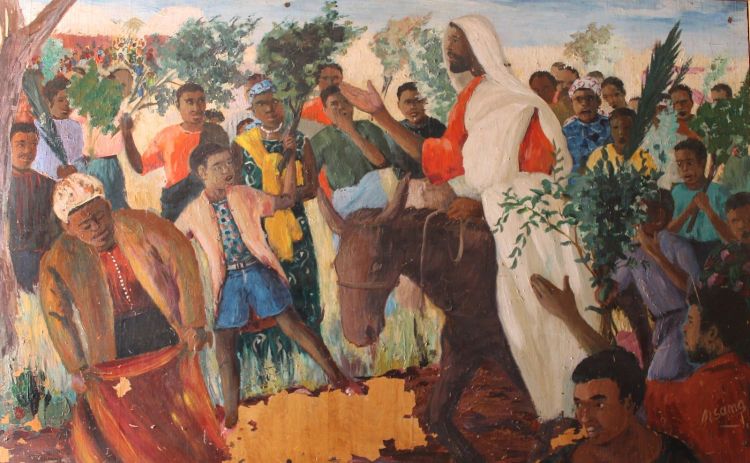
A very large crowd spread their cloaks on the road, and others cut branches from the trees and spread them on the road. The crowds that went ahead of him and that followed were shouting, “Hosanna to the Son of David! Blessed is the one who comes in the name of the Lord! Hosanna in the highest heaven!”
MATTHEW 21:8-9
Advent – Day 2
Monday, December 4
Amos 2:6-16
2 Peter 1:1-11
Matthew 21:1-11
In the United States, we live in a democratic system of government whose founding documents assert that “all men are created equal.”
Of course, we are all aware that this is an ideal that is beyond the grasp of our political reality. Daily we hear stories of the impact hunger, poverty, and homelessness have on segments of our population.

Our government readily supports countries engaged in conflicts abroad with billions of dollars in military spending, yet it doesn’t come anywhere near laying out similar amounts on health care, housing, nutrition, and other economic disparities on our own soil.
The turmoil that we are witnessing in our present time is fueled in large part by these inequalities.
And it would seem that since Christ walked the earth two thousand years ago, not much has changed.
In those days, the people were also full of expectations.
They were waiting for a savior. Not a spiritual redeemer, but a Messiah, someone who would rise up and overthrow the tyrannical empire that was currently in control.
And though it seems strange to read a text normally assigned to Palm Sunday in Advent, this Gospel reading from Matthew fits perfectly with the theme of hope that is stressed during the first week of Advent.
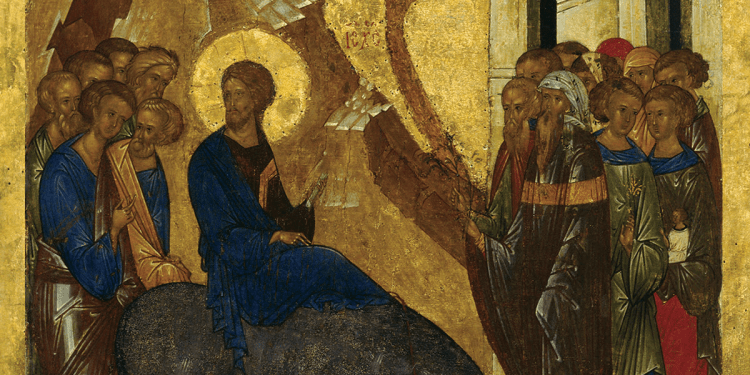
The scene takes place at the beginning of Passover, the holiest of Jewish holy days. Jerusalem is more crowded than usual, heightening the concerns of the Roman authorities, as well as the Jewish religious leadership, which has enjoyed a cozy relationship with Rome, as long as the crowds remain under control.
Jesus’ triumphant entry into Jerusalem threatens the status quo.
In their book, The Last Week: What the Gospels Really Teach about Jesus’ Last Days in Jerusalem, Marcus Borg and John Dominic Crossan point out that there were not one, but two processions into Jerusalem that day. [1]
On the opposite end of the city, Pontius Pilate, the Roman governor, was making an imperial entry complete with columns of soldiers. It was an imperial display of the empire’s military might, as well as a less than subtle warning of the fate that awaited insurrectionists should they entertain any thought of an ill-fated uprising.
This back story isn’t mentioned in the Gospels. But it gives us a better idea as to why Jesus’ spectacular entry into Jerusalem created such a stir.
Was he indeed the long-awaited Messiah who would restore the Kingdom of Israel, or merely a rabble rouser who advocated an overthrow of the established authority?
The Old Testament scholar Walter Brueggeman points out that: “Power, whenever and wherever it can, will present itself as a totalizing system, the wishful thinking of every empire, every regime, and every orthodoxy.” [2]
But God, on the other hand, desires to see all God’s people prosper – not just those who control the system.
In God’s Kingdom, the neediest in society are cared for. Social justice, when seen through the lens of Scripture, demands a focus on society’s problems. The Spirit cries out for the poor and the marginalized,
And God’s son, Jesus, during his time on earth, made that hopeful message the focus of his preaching and his actions.
The kingdom of God is a kingdom of sharing, a kingdom of compassion, a kingdom of abundance, a kingdom of justice, a kingdom of joyous harmony.
As we await the coming of Jesus during these days of Advent, whenever we read the term, “The Kingdom of God,” may we, as individuals and as a church, look at it as an invitation from Jesus to be a people who recognize the dignity of every human being.
Let us pray:
God of justice, fill us with your Spirit, that we may do what is in our power to make thy Kingdom come on earth. Amen.
[1] Marcus J. Borg and John Dominic Crossan, The Last Week: What the Gospels Really Teach about Jesus’ Last Days in Jerusalem (New York: HarperCollins: 2007), p. 2, ff.
[2] Walter Brueggemann, Truth Speaks to Power: The Countercultural Nature of Scripture (Louisville: Westminster John Knox Press:2013) p. 150.
 Walking Together in Faith