
THIRD SUNDAY OF ADVENT
DECEMBER 17, 2023
[And Mary said,] “My soul magnifies the Lord, and my spirit rejoices in God my Savior, for he has looked with favor on the lowliness of his servant. Surely, from now on all generations will call me blessed.”
Luke 1:46-48
Advent – Day 15
Sunday, December 17
Isaiah 61:1-4, 8-11
Psalm 126 or
Luke 1:46b-55
1 Thessalonians 5:16-24
John 1:6-8, 19-28
The daily readings are from the two-year daily lectionary as listed in the Book of Common Prayer, beginning on page 933.
The Sunday readings are from the Revised Common Lectionary, Year B.
There are more assigned readings than usual for this Third Sunday of Advent, giving pastors and congregations the option of using the Psalm or the reading from Luke, which is better known as “The Magnificat,” or “Mary’s Song.”
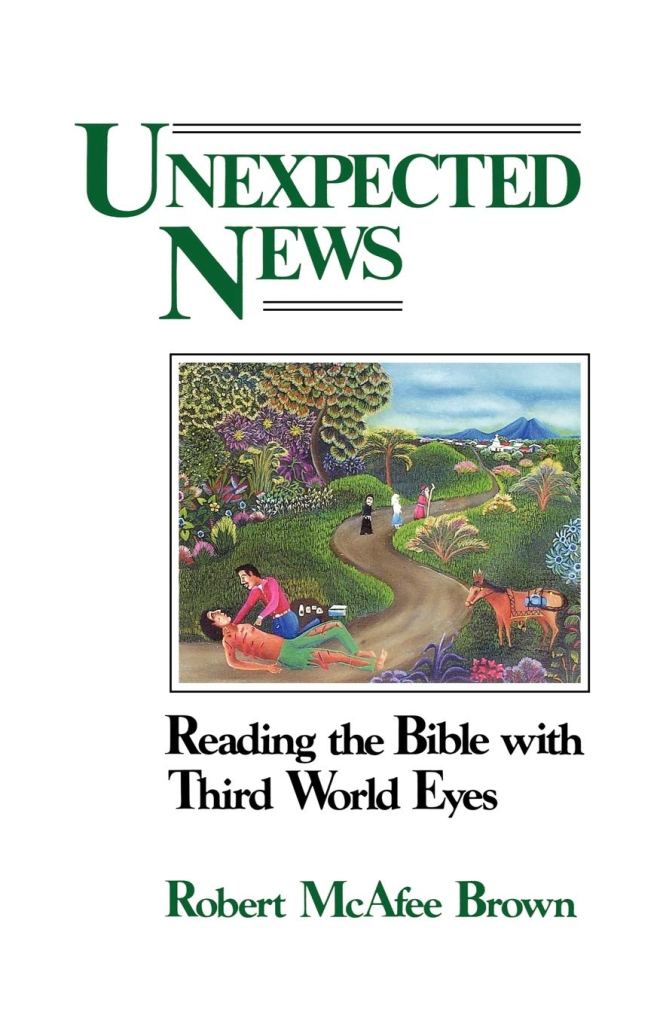
The following thoughts are not original. I’ve written them before several times and many of the thoughts are “borrowed” from Robert McAfee Brown’s essay titled, “Mary’s Song: Whom Do We Hear?” which appeared in his book Unexpected News: Reading the Bible with Third World Eyes (Philadelphia: Westminster Press, 1984).
Like most people in the pews, there was a time in my life that I heard the Magnificat as nothing more than pretty poetry. This talk about “scattering the proud in the thoughts of their hearts,” and “bringing down the powerful from their thrones,” was the stuff of fairy tales, comic books, and action movies. It just doesn’t happen in the real world.
Brown’s essay began the shift in my thought process. Those things do happen. Not all at once, and not everywhere, every time. However, as Brown states, “Political power is never secure, always vulnerable.”
(p. 79)
Scripture always takes seriously the human condition and the reality of sin, suffering and death.
That is where Mary, and more specifically, the Magnificat come into view.
The Magnificat is a revolutionary song. So revolutionary that it was banned in several countries in Latin America in the late 20th Century.
And perhaps some of us can understand why. Mary’s words sound outrageous. Mary’s declaration appears defiant. Mary’s claim doesn’t seem grounded in reality.
Mary interprets her present moment in light of who she understands God to be, in terms of God’s past history, God’s intentions, and God’s promises for the future.
In this way, she shows us how to speak about God in the here and now. She recalls established convictions about God’s character. And she imagines the possibility of God bringing a new future into being – not in a distant time, but beginning now, all around her, in her experience,
When we magnify the Lord, we embrace the vision of the whole world remade in the image of God.
When our spirit rejoices in God, the world and everything we hold dear is turned upside down and shaken and reshaped to fit a world of justice where people shall live secure, where peace and hope and joy and love will be the models which we follow.
There are several musical renditions of the Magnificat. My favorite is the version that is sung in Marty Haugen’s “Holden Evening Prayer.” After searching high and low on YouTube, the best I could find is from fourteen years ago posted by the Salesian Sisters of St. John Bosco in San Antonio. This will be our closing musical prayer for this day.
 Walking Together in Faith