Give the King your justice, O God,
[PSALM 72:1-4]
and your righteousness to the King’s Son;
That he may rule your people righteously
and the poor with justice.
That the mountains may bring prosperity to the people,
and the little hills bring righteousness.
He shall defend the needy among the people;
he shall rescue the poor and crush the oppressor.
| ADVENT DAILY OFFICE READINGS |
|---|
| AM Psalm 72 2 Samuel 7:1-17; Titus 2:11-3:8a; Luke 1:39-48a(48b-56) Christmas Eve: PM Psalm 89:1-29 Isa. 59:15b-21; Phil. 2:5-11 |
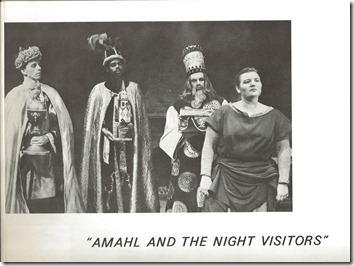
My junior year in college I had the distinct honor of being cast as Balthazar, one of the three wise men, in Gian Carlo Menotti’s classic Christmas opera Amahl and the Night Visitors.
The opera was an annual Christmas feature on television for many years during the fifties and sixties, and is still staged in many universities and theatre companies to this day.
Although it really is an Epiphany story, I bring it up here because it resonates with some of the themes in our psalm for the morning, Psalm 72 (see verses above).
It also touches upon economic, racial, and social justice concerns. Issues that were just as sensitive then, but perhaps less discussed publicly, and certainly not the central message of a theater production.
To briefly summarize the opera, on their way to pay tribute to Jesus, the three kings stop to rest at the house of a poor widow with a crippled son.
The youngster, Amahl, is as imaginative as he is curious and his interaction with the kings, especially in one scene with Balthazar, the Black king, brings the issue of race to the forefront.
AMAHL: Are you a real king?
BALTHAZAR: yes.
AMAHL: Have you regal blood?
BALTHAZAR: Yes.
AMAHL: Can I see it?
BALTHAZAR: (sighs, and says) it is just like yours.
AMAHL: What’s the use of having it then?
BALTHAZAR: (looks at Amahl quizzically and says simply) No use.
Later, as the kings sleep, the poor, desperate mother, overcome with temptation, tries to steal some of the gold. A brief confrontation erupts, and ends with King Melchior telling the mother she can keep the gold.
He sings:
O Woman, you may keep the gold;
the child we seek doesn’t need our gold.
On love, on love alone he will build his kingdom.
His pierced hand will hold no scepter;
his haloed head will wear no crown.
His might will not be built on your toil.
Swifter than lightning he will soon walk among us;
he will bring us new life, and receive our death.
And the keys to his city belong to the poor.
Then a miracle happens, Amahl regains his ability to walk!
So he accompanies the three kings to Bethlehem to pay homage to Jesus.
Tonight, many of you will attend some highly decorated house of worship to celebrate the Nativity of Our Lord.
There will be Christmas trees, flowers, choirs, brass bands, and other adornments. It will be a festive atmosphere.
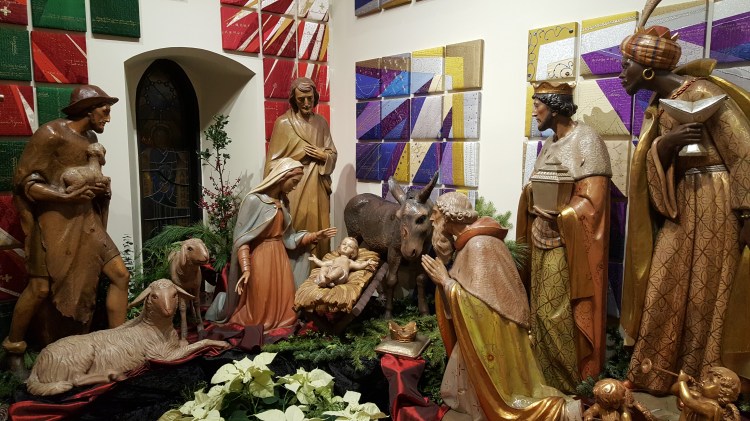
But I urge you to keep in mind that the first Christmas had none of that. If anything, it was the polar opposite.
Mangers were not the beautiful, clean places we see in our Christmas pageants. They are lonely, dirty, smelly places made for animals.
Jesus was born in a barn with a dirt floor. The air smelled of manure.
This is surely a strange way for a Savior to enter the world.
But Jesus comes at Christmas not just to warm hearts but to transform the living conditions of the world.
God has come among us in Jesus, and the world cannot remain the same.
Christmas is a time for confronting the reality of the bad news, and declaring that peace, justice, and righteousness have come into the world in Jesus Christ and will not be denied, because this is the birth of the King of the Universe!
Merry Christmas!
Let us pray:
God of every land and nation, you have created all people and you dwell among us in Jesus Christ. Listen to the cries of those who pray to you, and grant that, as we proclaim the greatness of your name, all people will know the power of love at work in the world. We ask this through Christ our Lord. Amen.
(Revised Common Lectionary Prayers, p. 51)
*The Psalter in the Book of Common Prayer breaks up the verses into shorter segments for music and chanting purposes.
 Walking Together in Faith