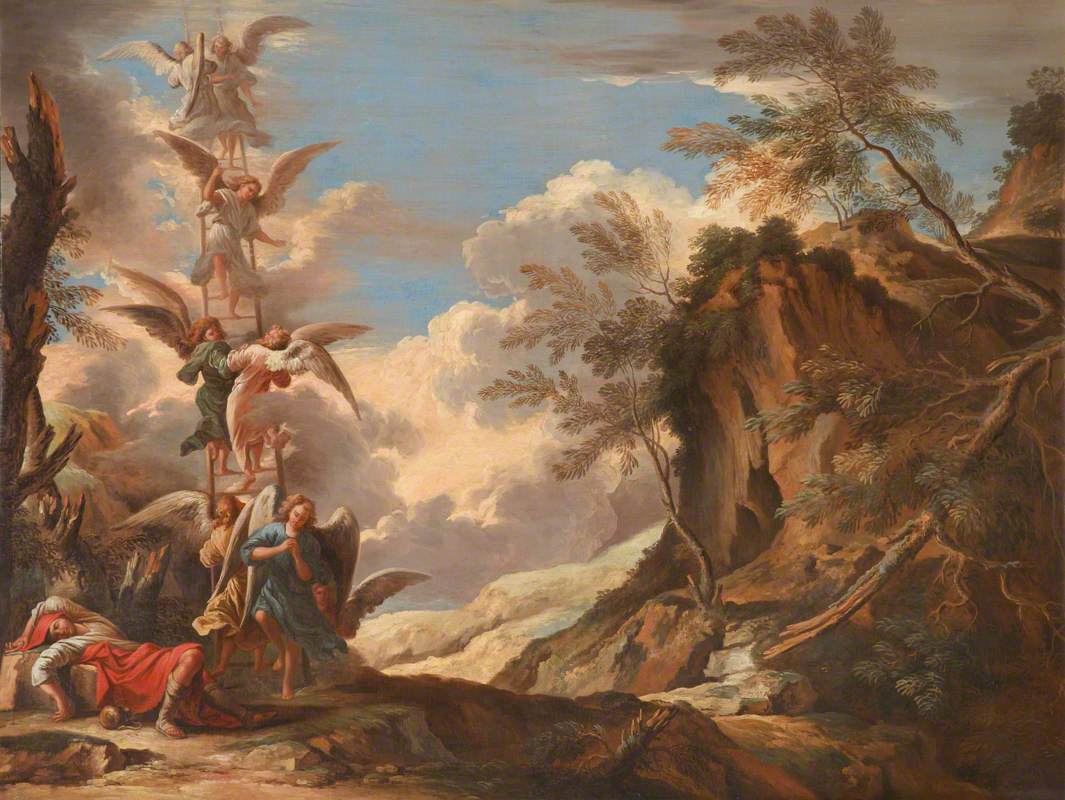
Jacob left Beer-sheba and went toward Haran. He came to a certain place and stayed there for the night, because the sun had set. Taking one of the stones of the place, he put it under his head and lay down in that place. And he dreamed that there was a ladder set up on the earth, the top of it reaching to heaven; and the angels of God were ascending and descending on it.
[Genesis 28:10-12 NRSV]
| DAILY OFFICE READINGS – February 13, 2026 |
|---|
| AM Psalm 88; PM Psalm 91, 92 Gen. 27:46-28:4,10-22; Rom. 13:1-14; John 8:33-47 |
Jacob’s dream has to be one of the most lasting and captivating images of the connection between heaven and earth.
I can still remember it as one of those felt-board Sunday School lessons that I learned in my childhood along with Noah’s Ark and Daniel in the lion’s den.
But here’s the thing.
Jacob is far from the best example of an upright character.
To say he was deceptive is putting it mildly.
Jacob lied to his father Isaac and stole the birthright from his brother Esau.
Deception seems to run in the family.
His grandfather, Abraham, lied to the Egyptians and told them his wife Sarah was his sister. Isaac did the same with his wife, Rebekah. So the apple didn’t seem to fall far from the tree.
At the time of this dream, Jacob is running away from his brother Esau, who had sworn to kill him.
Yet in the dream God appears to Jacob and tells him not to worry. “Know that I am with you and will keep you wherever you go, and will bring you back to this land; for I will not leave you until I have done what I have promised you.” (v. 15)
It never ceases to amaze me that God used people like Jacob, imperfect as they were, to create the line of descendants that would eventually bring us a Savior – our Lord Jesus Christ.
But let’s put Jacob’s character flaws aside for a minute and talk about the ladder.
Jacob’s ladder became the symbol of a connection between Heaven and earth for Black slaves in the United States. It is from that image that the spiritual, “We Are Climbing Jacob’s Ladder” emerged.
| 1 We are climbing Jacob’s ladder, We are climbing Jacob’s ladder, We are climbing Jacob’s ladder, Soldiers of the cross. | 3 Sinner do you love your Jesus? Sinner do you love your Jesus? Sinner do you love your Jesus? Soldiers of the cross. |
| 2 Ev’ry round goes higher, higher Ev’ry round goes higher, higher Ev’ry round goes higher, higher Soldiers of the cross. | 4 If you love Him why not serve Him, If you love Him why not serve Him, If you love Him why not serve Him, Soldiers of the cross.1 |
The origins of the song are unknown. Sources date its composition somewhere between 1750 and 1875.
The power of song in the struggle for black survival is the premise upon which theologian James Cone wrote the book The Spirituals and the Blues.
The black experience in America is a history of servitude and resistance, of survival in the land of death. It is the story of black life in chains and of what that meant for the souls and bodies of black people. This is the experience that created the spirituals, and it must be recognized if we are to render a valid theological interpretation of these black songs. 2(Cone, p. 20)
In his book, Deep River, theologian Howard Thurman analyzes the appeal of “Jacob’s Ladder” in this manner:
There is something in every one of us that tries ever to reach beyond the known, the realized, the given, the particular. The struggle never seems to be resolved; man, the earth-bound creature, with his mind and spirit moving in and out among the stars…We see this same principle illustrated in other practical aspects of human experience. (p. 81)
We are all climbing Jacob’s ladder, and every round goes higher and higher. All who recognize this as a living part of their experience join with those early destiny-bound singers who marched through all the miseries of slavery confident that they could never be entirely earth-bound. 3(p. 86)
Cone further adds that, “To be a person is to be in control of one’s destiny, to set certain concrete limitations on the movement of self and of other selves in relation to self.” (Cone, p. 21)
February is Black History Month and this year is its 50th anniversary.
Yet this year, the celebration of Black History Month finds itself under siege.
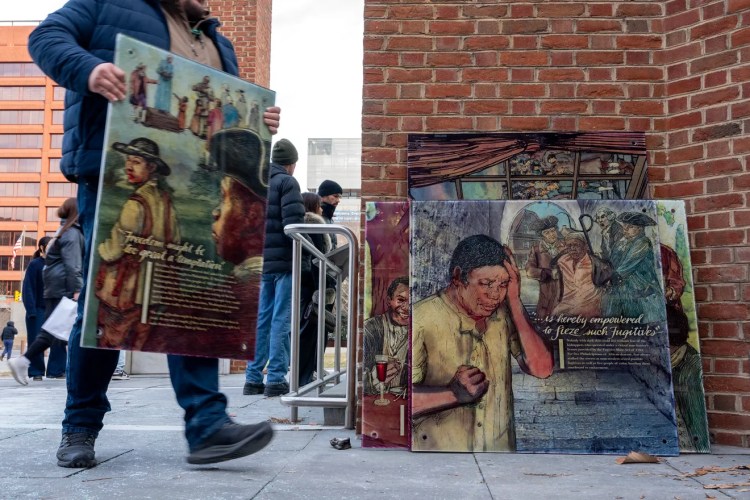
Black monuments are being dismantled by the current administration. The achievements of African Americans are being eliminated from public display. All federal departments and offices have been ordered to abolish diversity programs.
Generations have fought for inclusion in the historical record, yet now the administration of the current President resists acknowledging black humanity.
White supremacists have been given a permission structure to denigrate any and all things that highlight black accomplishments by a bigoted President who blatantly posts racist tropes of Barack and Michelle Obama, the first black family to occupy the White House
The symbolism of Jacob’s Ladder is perhaps of utmost importance in this day and age.
It is my fervent prayer that, like Jacob, God can take all the flaws of this current federal administration and use it for good.
In the meantime, everyone – not just African Americans – everyone, must continue to climb that ladder in pursuit of justice for those who are oppressed, keeping in mind God’s promise that, “I am with you and will keep you wherever you go.”
Let us pray:
Grant, O God, that your holy and life-giving Spirit may so move every human heart and especially the hearts of the people of this land, that barriers which divide us may crumble, suspicions disappear, and hatreds cease; that our divisions being healed, we may live in justice and peace; through Jesus Christ our Lord. Amen.
(Book of Common Prayer p. 823)
- Lift Every Voice and Sing II: an African American Hymnal #220 ↩︎
- Cone, James H. The Spirituals and the Blues. (Maryknoll: Orbis Books, 1972) ↩︎
- Thurman, Howard. Deep River: The Negro Spiritual Speaks of Life and Death. (Richmond: Friends United Press, 1975) ↩︎
Feature Image: Rosa, Salvator, 1615-1673; Landscape with Jacob’s Dream
 Walking Together in Faith