On that day, when evening had come, he said to them, ‘Let us go across to the other side.’ And leaving the crowd behind, they took him with them in the boat, just as he was. Other boats were with him. A great gale arose, and the waves beat into the boat, so that the boat was already being swamped. But he was in the stern, asleep on the cushion; and they woke him up and said to him, ‘Teacher, do you not care that we are perishing?’ He woke up and rebuked the wind, and said to the sea, ‘Peace! Be still!’ Then the wind ceased, and there was a dead calm. He said to them, ‘Why are you afraid? Have you still no faith?’ And they were filled with great awe and said to one another, ‘Who then is this, that even the wind and the sea obey him?’
[Mark 4:35-41 NRSV]
| DAILY OFFICE READINGS – March 6, 2026 |
|---|
| AM Psalm 95 [for the Invitatory] 69:1-23(24-30)31-38; PM Psalm 73 Gen. 43:1-15; 1 Cor. 7:1-9; Mark 4:35-41 |
I confess that this is one of those days I wish I hadn’t committed to writing a blog post twice weekly.
I’ve told myself that grace gives me the right to take an occasional break, but when I do, I feel guilty for not having written anything and I spend the rest of the day brooding. So if this doesn’t quite live up to what you’ve been accustomed to reading, I will apologize in advance.
You’ll note that I wrote out the entire Gospel passage rather than a random verse or two, so this may also begin to sound like a sermon.
My wife and I used to take a week in the summer to vacation on Kelley’s Island. (For the non-Ohioans, it’s one of the Lake Erie islands, just off the coast of Sandusky, near Cedar Point Amusement Park.)
To get there one has to travel by boat.
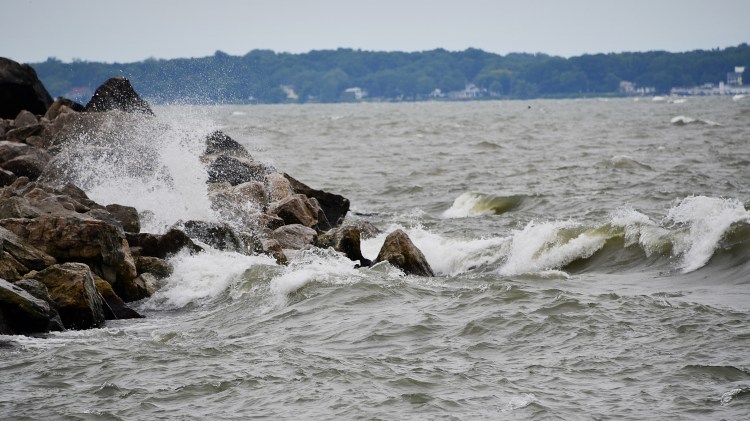
Normally, it’s a pretty easy trip. But one year, there was a storm and the ferry line shut down. So we spent the night at a hotel on the mainland.
It gave me a chance to observe the lake at its fiercest, something I had never seen before.
The Great Lakes can be violent when storms arise, and sometimes, they are deadly. The Canadians singer Gordon Lightfoot immortalized one of those tragedies in his classic “The Wreck of the Edmund Fitzgerald,” a haunting melody that detailed the sinking of an ore boat in November of 1975 in which twenty-nine sailors were drowned.
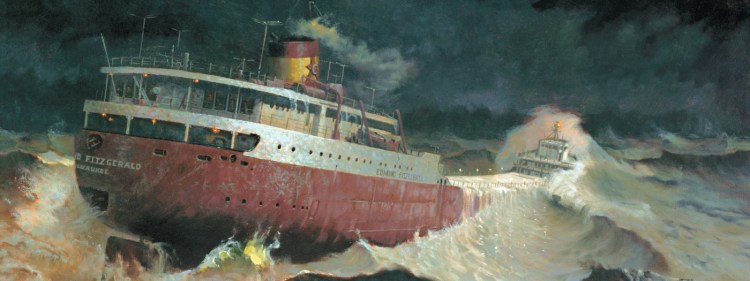
The Great Lakes Shipwreck Museum, Paradise, MI
I thought about that song that day from the safety of the shore, and I can’t imagine what it would have been like to have been on the Kelley’s Island ferry at the height of the turbulence.
I would have probably been just as frightened as the disciples on the boat with Jesus. Perhaps even more so.
The key question in this Gospel narrative comes as they wake him up from what appears to be a sound slumber. “Teacher, do you not care that we are perishing?”
We are going through stormy times at the moment. I don’t need to tell you what they are.
And when that happens, which is more often than we want, we also tend to have similar questions.
Where is God during these difficult times? Is God asleep, or does God just not care?
Our plea becomes like that of the psalmist in our Psalm reading for this day (Psalm 69:1-4)
Save me, O God,
for the waters have risen up to my neck.I am sinking in deep mire,
and there is no firm ground for my feet.I have come into deep waters,
and the torrent washes over me.I have grown weary with my crying;
my throat is inflamed;
my eyes have failed from looking for my God.
But Jesus’ question to the disciples, and by extension to us, is just as convicting, and at the same time comforting.
“Why are you afraid? Have you still no faith?”
We tend to forget that in this boat that we call life, Jesus is in the boat with us.
And it is in prayer that we discover that Jesus is present, even when he seems most absent.

The priest Henri Nouwen has written countless books on the life of prayer. In Reaching Out: The Three Movements of the Spiritual Life, he makes these points:
It is in the center of our longing for the absent God that we discover his footprints, and realize that our desire to love God is born out of the love with which he has touched us. (p. 128)
We are tempted to grasp rapid solutions instead of inquiring about the validity of the questions. (p. 129)
When in a crisis of war, sudden poverty, illness or death we are confronted with the “absurdities of life,” we can no longer remain neutral and are asked to respond. Often our first and most visible response is a protest bursting forth from our bewilderment. It is at these crucial moments of life that we are reminded again of our illusions and asked to convert our protest into prayer. (p. 131)
To be clear, prayer will not necessarily calm the waters of the storm, but knowing that God is with us on the journey will give us the faith to drown our fears, no matter how long it takes, until we reach the calm of the other side.
Let us pray:
O God of peace, you have taught us that in returning and rest we shall be saved, in quietness and confidence shall be our strength: By the might of your Spirit lift us, we pray, to your presence, where we may be still and know that you are God; through Jesus Christ our Lord. Amen.
(Book of Common Prayer edited p. 832)
Nouwen, Henri J. M. Reaching Out: The Three Movements of the Spiritual Life. New York: Doubleday, 1975.
 Walking Together in Faith