The Lord is King; let the earth rejoice;
[PSALM 97:1-2 bcp PSALTER]
let the multitude of the isles be glad.
Clouds and darkness are round about him,
righteousness and justice are the foundations of his throne.
| DAILY OFFICE READINGS – March 17, 2026 |
|---|
| AM Psalm 97, 99, [100]; PM Psalm 94, [95] Gen. 49:29-50:14; 1 Cor. 11:17-34; Mark 8:1-10 |
Given that today is St. Patrick’s Day, I feel compelled to share with you a story that has absolutely no value other than providing a joyful dose of humor.
It seems that an Irishman moves into a tiny hamlet in County Kerry, walks into the pub and promptly orders three beers. The bartender raises his eyebrows, but serves the man three beers, which he drinks quietly at a table, alone.
The next evening the man again orders and drinks three beers at a time, several times. Soon the entire town is whispering about the Man Who Orders Three Beers.

Finally, a week later, the bartender approached the man on behalf of the town. “I don’t mean to pry, but folks around here are wondering why you always order three beers?”
“‘Tis odd, isn’t it?” the man replies, “You see, I have two brothers, and one went to America, and the other to Australia. We promised each other that we would always order an extra two beers whenever we drank as a way of keeping up the family bond.”
The bartender and the whole town was pleased with this answer, and soon the Man Who Orders Three Beers became a local celebrity and source of pride to the hamlet, even to the extent that out-of-towners would come to watch him drink.
Then, one day, the man comes in and orders only two beers. The bartender pours them with a heavy heart. This continues for the rest of the evening: he orders only two beers. The word flies around town. Prayers are offered for the soul of one of the brothers.
The next day, the bartender says to the man, “Folks around here, me first of all, want to offer condolences to you for the death of your brother. You know – the two beers and all…”
The man ponders this for a moment, then replies to the puzzled bartender, “You’ll be happy to hear that my two brothers are alive and well. It’s just that I, myself, have decided to give up drinking for Lent.”
On a more serious note, the following background on the significance of this day is excerpted from Lesser Feasts and Fasts, the Episcopal collection of commemorations:
Patrick was born into a Christian family somewhere on the northwest coast of Britain around 390. His grandfather had been a Christian priest and his father, Calpornius, a deacon. Calpornius was an important official in the late Roman imperial government of Britain.
When Patrick was about sixteen, he was captured by a band of Irish slave-raiders. He was carried off to Ireland and forced to serve as a shepherd. When he was about twenty-one, he escaped and returned to Britain, where he was educated as a Christian. He tells us that he was ordained as both priest and bishop, although no particular see is known as his at this time. A vision then called him to return to Ireland, and he did so around the year 431.
Many legends of Patrick’s Irish missionary travels possess substrata of truth, especially those telling of his conversion of the three major Irish High Kings. At Armagh, he is said to have established his principal church. To this day, Armagh is regarded as the primatial see of all Ireland.
Two works are attributed to Patrick: an autobiographical Confession, in which he tells us, among other things, that he was criticized by his contemporaries for lack of learning, and a Letter to Coroticus, a British chieftain. The Lorica or St. Patrick’s Breastplate (“I bind unto myself today”) was probably not written by him, dating most probably from the eighth century rather than from the fifth, but it does express his faith and zeal.
Patrick died at Saul in County Down in 461.
The following information on the celebration of this day is found on the History.com website:
Since around the ninth or 10th century, people in Ireland have been observing a Roman Catholic feast day honoring St. Patrick on March 17. The first St. Patrick’s Day parade took place not in Ireland but in North America. Records show that a St. Patrick’s Day parade was held on March 17, 1601, in the Spanish colony of St. Augustine, Florida.
More than a century later, homesick Irish soldiers serving in the British military marched in New York City on March 17, 1762, to honor the Irish patron saint. Enthusiasm for the St. Patrick’s Day parades in New York City, Chicago and Boston and other early American cities only grew from there.
Blessings to you this St. Patrick’s Day!
Let us pray:
Almighty God, in your providence you chose your servant Patrick to be the apostle to the Irish people, to bring those who were wandering in darkness and error to the true light and knowledge of you: Grant us so to walk in that way that we may come at last to the light of everlasting life; through Jesus Christ our Lord, who lives and reigns with you and the Holy Spirit, one God, now and ever. Amen.
(Lesser Feasts and Fasts, p. 139)
Note: I am taking a break from posting this Friday, March 20. My next post will appear next Tuesday, March 24. Enjoy the week.
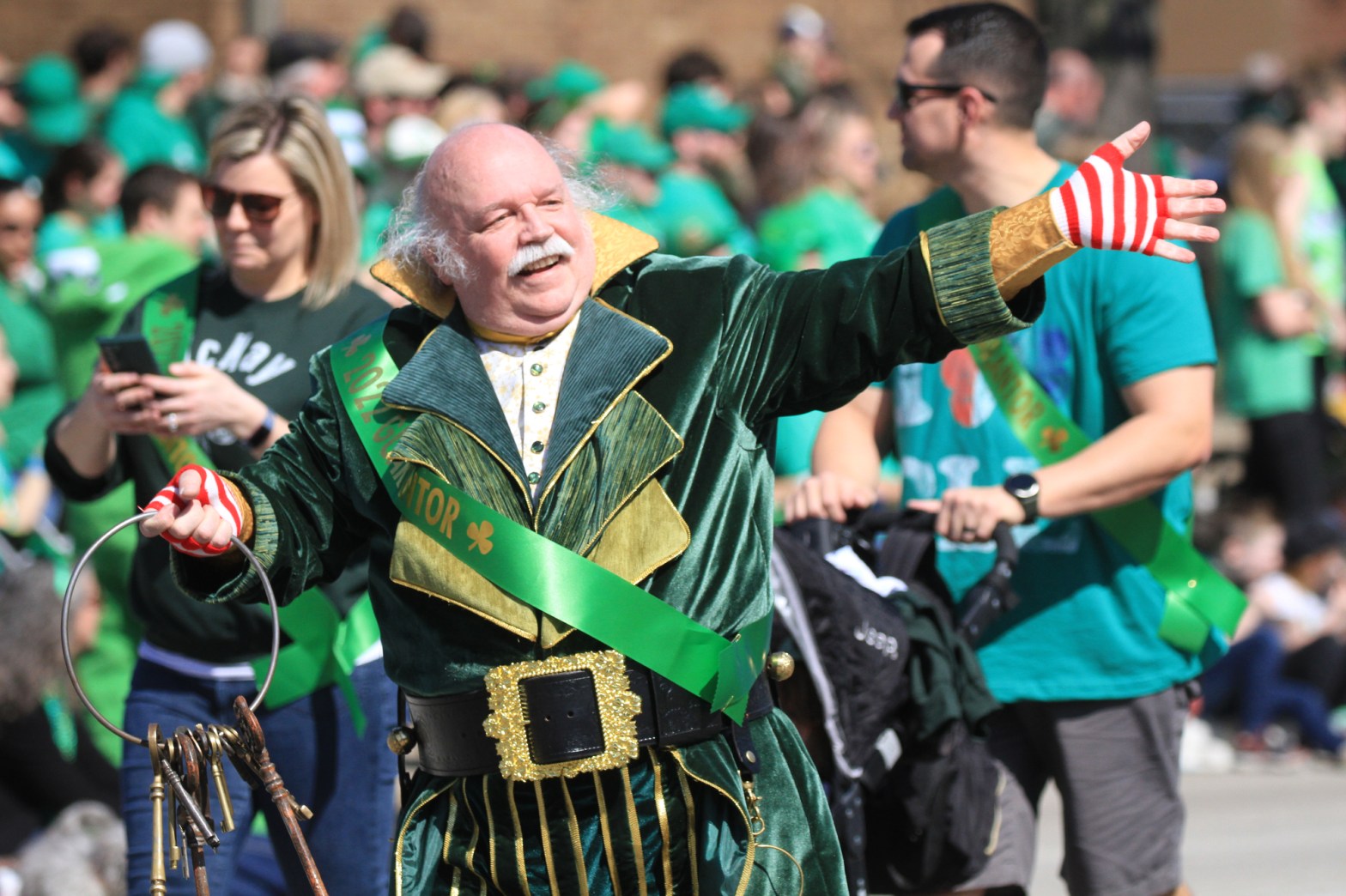
Feature Image: A scene from the Cleveland St. Patrick’s Day Parade in 2022, courtesy of Cleveland.com
 Walking Together in Faith
Liked and shared on Facebook. Good story.
LikeLike