“Because the needy are oppressed,
[psalm 12:5 bcp psalter]
and the poor cry out in misery, “
I will rise up,” says the Lord,
“and give them the help they long for.”
| DAILY OFFICE READINGS – March 31, 2026 |
|---|
| AM Psalm 6, 12; PM Psalm 94 Lam. 1:17-22; 2 Cor. 1:8-22; Mark 11:27-33 |
It is Tuesday in Holy Week, and I have to confess that I feel a little lost.
For the first time in five years, I have no responsibilities and no place to be on this day.
During all my time in ordained ministry, Tuesday of Holy Week has been a day of worship, with the exception of the COVID years, 2020 and 2021.
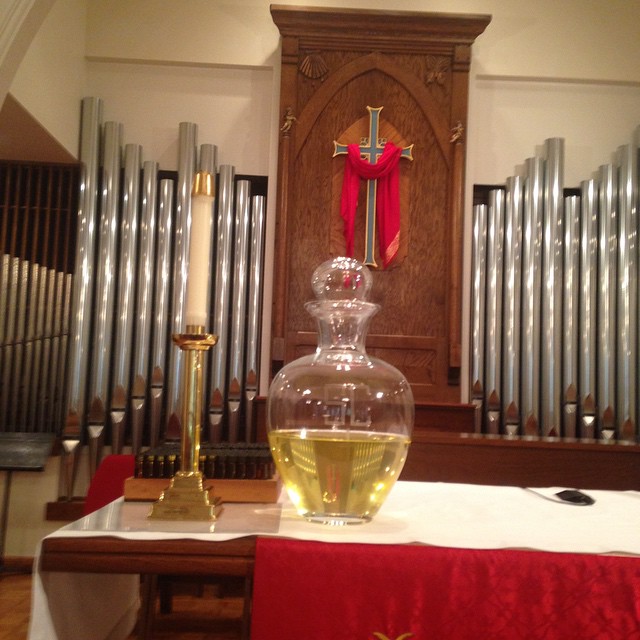
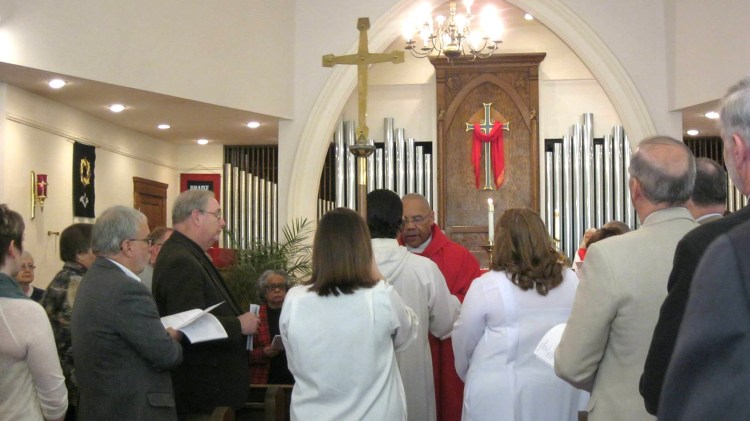
This was the day that our synod held a Chrism Mass, a service in which clergy renewed their ordination vows and the oils that would be used in healing and anointing liturgies over the coming year would be blessed.
Sadly, both my Lutheran and my adopted Episcopal judicatories have decided to reschedule this gathering to another less demanding time of the year.
Since it is not an obligation, I know many colleagues who would skip it because they have never found this particular service invigorating or revitalizing.
For me, it was the exact opposite, a totally exhilarating experience, whether as a worshipper or worship leader.
Yet the collective complaints have escalated over the past decade. I heard them when I served in the office of bishop:
Why would we hold this service on the most demanding week of a minister’s life?
Why do we disrupt the busy-ness of preparation for the multiplicity of liturgies just to drag you out of your routine to – of all things – worship?
The objection of the clergy was reflected in the decrease in attendance, I imagine to the point that the conclusion to reschedule was the inevitable outcome.
I do not write to protest these decisions. I respect the wisdom of those who have made them. I understand the logic and I will attend whenever it is held. I am simply expressing my personal dismay.
I hate to come off sounding like an old grouch (which perhaps I am!), or a voice crying in the wilderness, longing for the good old days.
A decade ago, I came across a reflection by an Episcopal priest, Kira Austin-Young, who wrote the following:
“In the midst of an incredibly divisive and tense political season, this year I find myself in need of Holy Week more than ever. This is, after all, the pinnacle of the church year, leading up to the reason we are here as Christians in the first place — the resurrection.”
Mind you, this was written in 2016!
She goes on to state:
“I long for the cross’ critique of worldly power particularly in this political season full of divisive and dangerous rhetoric. By entering into the worst possible moment, the death of Christ at the hands of empire, and knowing that is not the final word, I can take comfort in our current moment. The worst thing is not the final thing.”
Not much has changed in a decade. In fact, things in the world may be worse!
The church has lost its glory-day luster in many parts of Christendom. Our culture promotes a gospel of consumerism, divisiveness, and antagonism. We are held captive to our own desires and broken in so many ways. Globally we face challenges more daunting than ever before with poverty, famine, climate change, economic injustice, and warfare.
And against all these obstacles, the people look to us, the clergy, for hope.
Ministry is not a solitary enterprise. We need each other, to support each other, and to strengthen each other in carrying out God’s mission. A few hours together is one way to be assured that God has not abandoned us.
Holy Week is the test of whether we can summon that sort of love within ourselves for Jesus.
It is exactly that sort of love that we can often look back on and recognize in God’s response to our own dark moments.
God doesn’t abandon us, but neither does God very often step in and fix us or our circumstances. God stands with us with the bravest and strongest love of all, the love that undergoes suffering with us rather than sparing us.
I commend those judicatories that continue to provide the Chrism Mass for their pastors, priests, and deacons on Holy Week.
I pray that in the future, ours will reconsider a return to this time-honored practice.
Let us pray:
O God, by the passion of your blessed Son you made an instrument of shameful death to be for us the means of life: Grant us so to glory in the cross of Christ, that we may gladly suffer shame and loss for the sake of your Son our Savior Jesus Christ; who lives and reigns with you and the Holy Spirit, one God, for ever and ever. Amen.
(Book of Common Prayer, p. 220)
 Walking Together in Faith