And when Jesus had been baptized, just as he came up from the water, suddenly the heavens were opened to him and he saw God’s Spirit descending like a dove and alighting on him. And a voice from the heavens said, “This is my Son, the Beloved, with whom I am well pleased.”
[matthew 3:16-17 nrsvue]
The question I am most asked about our recent cruise to the British Isles is, “What did I find most interesting?”
It’s a difficult question to answer because, having never been there before, everything was new and interesting.
However, given my vocation, my curiosity is always drawn toward historic religious sites.
I am in a state of constant fascination with churches and cathedrals that were built before this country was even a figment of one’s imagination.
These magnificent structures were built without modern construction equipment. The workers who began the task could only imagine what the final product would look like since none of them would ever witness the finished project.
And yet, despite their age, these holy places have been maintained and modernized to fit the needs of those who frequent the sites, whether on a regular basis or merely out of inquisitiveness.
Once inside a sanctuary, my eyes seek out the baptismal font.
Baptizing a newcomer to the faith, whether an infant or adult, is the most sacred act I feel blessed to fulfill as a pastor in service to Christ.
For us who worship in a liturgical tradition, it is the initial step into a life of faith. I don’t feel it is an exaggeration on my part to compare the joy of baptizing to that of giving birth to a child.
In ancient Roman practices the baptistery was often a separate building, housing a large pool, emphasizing that one must be baptized before being allowed to enter the main church.
Thankfully, that is not the modern custom. Nevertheless, we are accustomed to seeing the font at the entrance to the nave. Yet, for a variety of reasons, that is not always the case.
So when I visit any church for the first time, I seek out the font and spend a few minutes in meditation taking in the magnificence of the creation.
There’s always a story behind each font. But because all of our building visits felt rushed, I had to look up these stories after returning home.
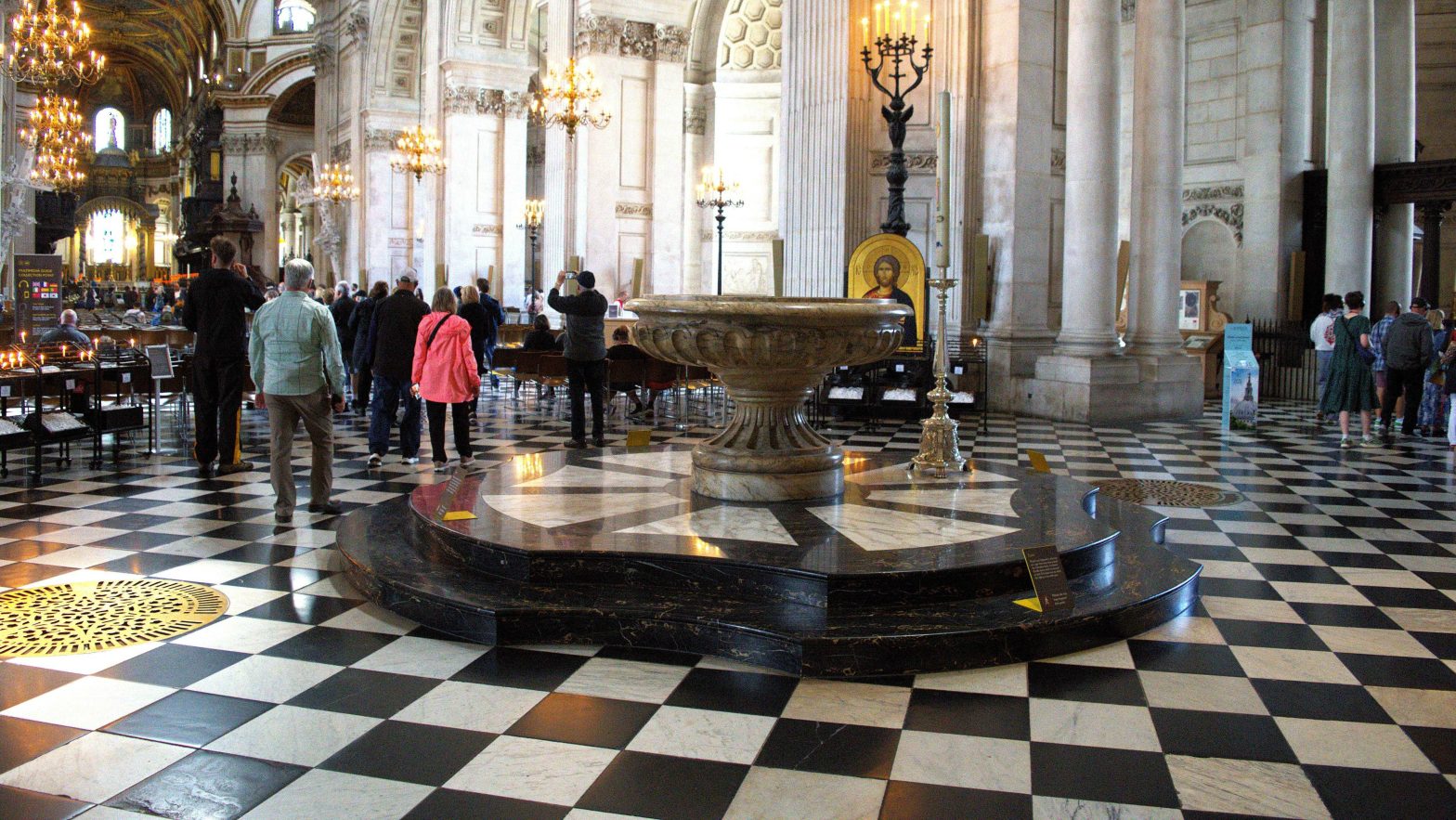
The font pictured at the top of this post, from St. Paul’s Cathedral in London, was the largest one I saw and one of the two most impressive. The sculptor Francis Bird carved it between 1726 and 1727, several years after the main construction of the Cathedral was completed in 1710.
Interestingly, there was a baptism scheduled for the day that we visited the cathedral. Unfortunately, our tour group was on a tight schedule and we couldn’t pause to witness it.
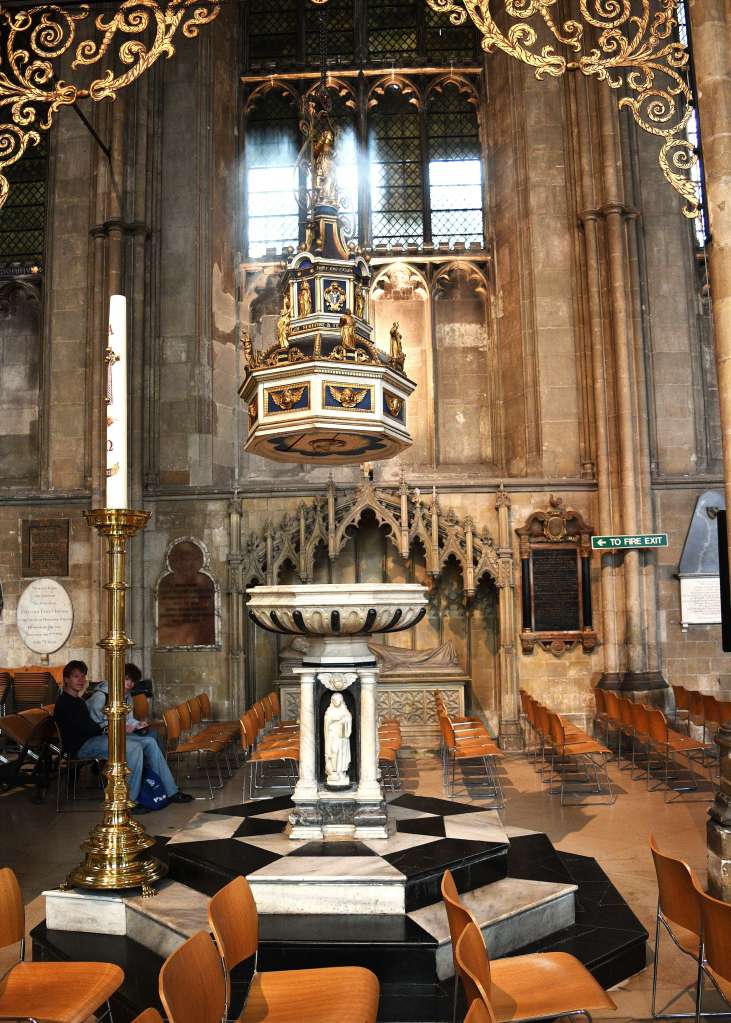
The other was the font at Canterbury Cathedral.
Though not as large as St. Paul’s, it is much more detailed. It was a gift to the Cathedral from Canon John Warner to mark his promotion to Bishop of Rochester in 1639.
The four-sided base of the ornate font contains statues of the four evangelists, while the two-story cover depicts each of the twelve apostles. The cover is drawn by a pulley system.
Shockingly, it was smashed by Oliver Cromwell’s Puritan soldiers just three years later. The brazen act was committed because the ornamentation of the font clashed with their strict iconoclastic beliefs. But luckily, a quick-thinking William Somner, the cathedral Proctor (lawyer), gathered the broken pieces and hid them.
The font was then reassembled in 1663. And the first person to be baptized in the refurbished font, appropriately, was Somner’s daughter, Barbara.
Compared to these two striking fonts, the others I saw were rather pedestrian.
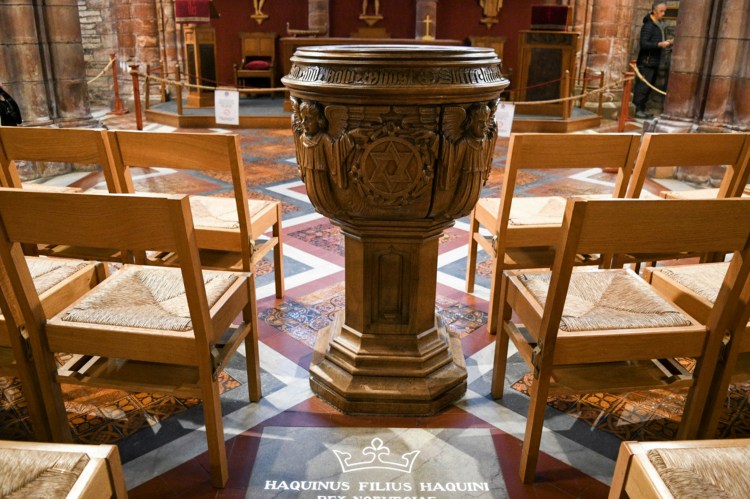
Kirkwall, Orkney Islands, Scotland
St. Magnus Cathedral, located in Kirkwall, the largest town in the Orkney Islands north of Scotland, is billed as Britain’s most Northerly cathedral.
Not only that, over centuries, as the islands changed hands, the worshipping community has been part of the Roman Catholic Church, the Norwegian Church (Lutheran), the Scottish Episcopal Church, and the Church of Scotland (Presbyterian).
Their website proudly proclaims that its worshipping community thus inherits an ecumenical tradition. (I would label it eclectic!)
The original font in the photo above is made of intricately carved wood and was built in 1883.
It is located near the high altar.
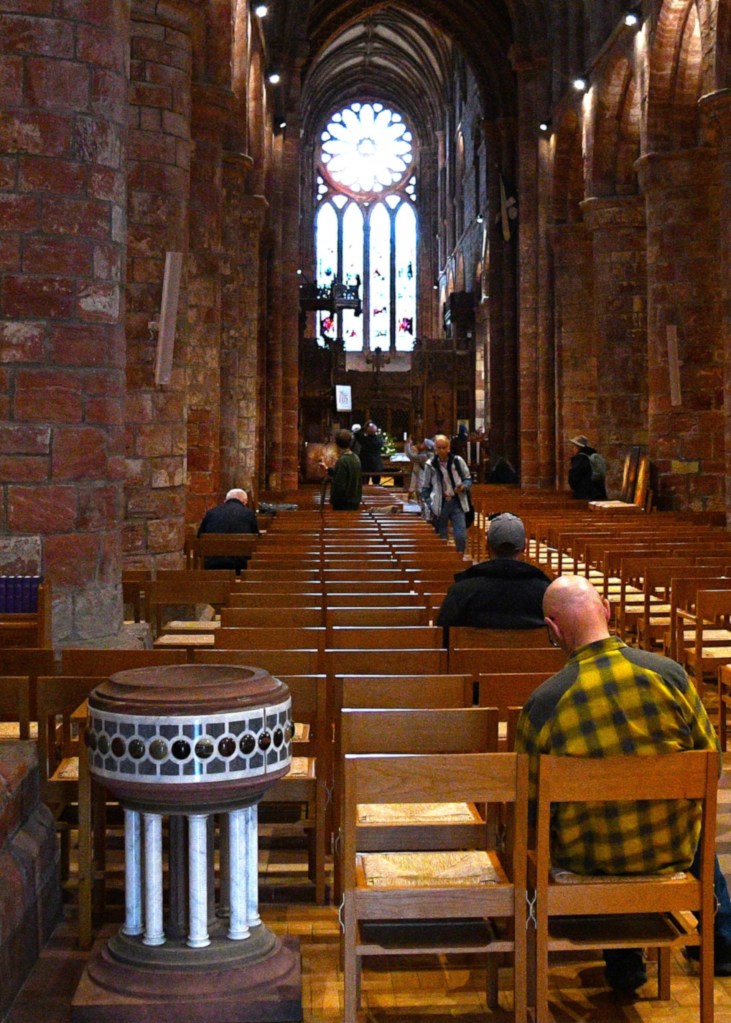
Surprisingly, it is not the main font, which is located at the entrance. Because it is so much smaller, it is easy to miss. Admittedly, I mistakenly walked right past it upon entering the cathedral, overlooking its significance because of its size.
The main font is very new (1987), made of marble, local Orkney stones, and sandstone. A ring of stones is inlaid around the edge of the bowl, representing every island and parish in the Orkney archipelago.
As in Kirkwall, most Scottish churches have undergone various permutations over the centuries.
In Aberdeen, Scotland, there is St. Machar’s Cathedral, which is a misnomer since the Church of Scotland is Presbyterian. The Kirk, as churches are known, has kept the term cathedral to honor the history of the building, which had its origins in the Sixth Century.
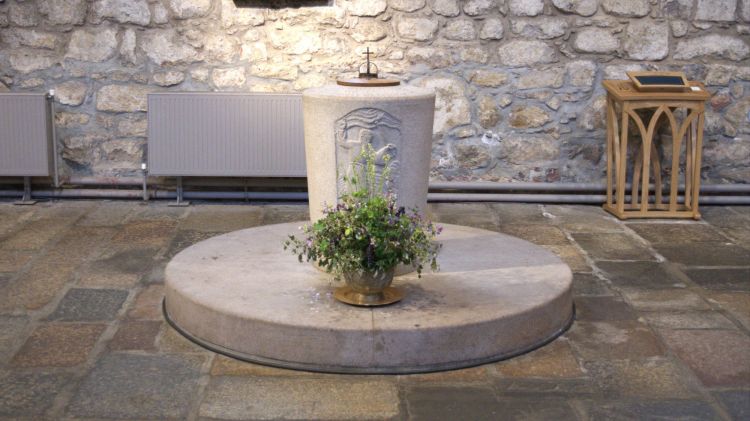
The granite font, located in the north aisle, is also relatively new. Built in 1954, it features a relief carving that depicts St. Machar baptizing converts in the nearby River Don, again, as a nod to the church’s past.
Perhaps no other country’s history and culture has been so largely shaped and influenced by politics and religion as Great Britain’s.
These fonts, for me, serve as a reminder that our sense of identity in baptism overrides the historical, cultural and political elements that govern the world.
Because we are baptized in Christ, we are affirmed and confirmed as children of God rather than citizens of an earthly kingdom, an ethnicity, or even a worship tradition.
Because we are baptized, we can rest assured that God is with us throughout all of the world’s seemingly endless conflicts, and we have a peace which passes all understanding that will guard our hearts and minds in Christ Jesus.
Let us pray:
All praise and thanks to you, most merciful Father, for adopting us as your own children, for incorporating us into your holy Church, and for making us worthy to share in the inheritance of the saints in light; through Jesus Christ your Son our Lord, who lives and reigns with you and the Holy Spirit, one God, for ever and ever. Amen.
(Book of Common Prayer, p. 311)

