
Then the king will say to those at his right hand, ‘Come, you who are blessed by my Father, inherit the kingdom prepared for you from the foundation of the world, for I was hungry and you gave me food, I was thirsty and you gave me something to drink, I was a stranger and you welcomed me, I was naked and you gave me clothing, I was sick and you took care of me, I was in prison and you visited me.’
[matthew 25:34-36 nrsvue]

We see the poor, the hungry, and the unhoused just about everywhere we turn these days.
Whether sleeping on park benches, holding a sign at the off-ramps of highways, warming up or using the computers in public libraries, they’ve become a presence that is hard to ignore.
And yet, many of us do.
We turn our heads and look elsewhere, not wanting to be reminded of how well off we are compared to them.
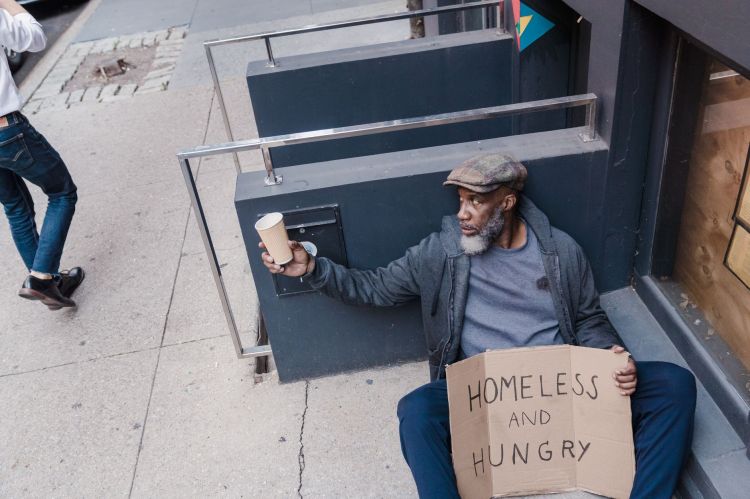
If we do give something to anyone holding a hand out, we do it quickly, hurriedly, gazing straight ahead to avoid making eye contact with the one we are assumedly helping.
It’s at this time of the year, as the weather gets colder, that the Salvation Army bell ringers reappear at store entrances and shopping areas.
Social service agencies flood our mailboxes with donation requests.
Even our churches get into the act.
Someone slips in a reminder or two during Sunday announcements that the grocery distribution, or the hot meal ministries could make good use of our time or our money.
And in this Sunday’s Gospel, we’ll hear…wait for it…the granddaddy of them all – the parable of the sheep and the goats! (Matthew 25:31-46, click on the link to read the full passage.)
Right before Thanksgiving!
Could we be made to feel any more guilty?
Okay, calm down. Take a breath.
Hopefully, the following analogy will help ease your anxiety.
Years ago, there was a reality show on TV called Undercover Boss.
Each week the program followed a different executive as they left the comfort of their familiar surroundings in their corporate office and went on an undercover fact-finding mission to examine how their company really functions.
Disguised, they worked alongside their employees, who had no clue who this person was (which I found hard to believe, by the way).
The executives saw the effects that their decisions had on others – what worked and what didn’t. They discovered which employees went above and beyond their job description, and who were the slackers.
At the end of the episode, to the utter surprise of the employees, the CEO revealed his or her true identity and shared his or her observations.
To put it in the context of our gospel lesson, the Son of Man in our parable – Jesus – is the Undercover Boss.
This Sunday we celebrate Christ the King.
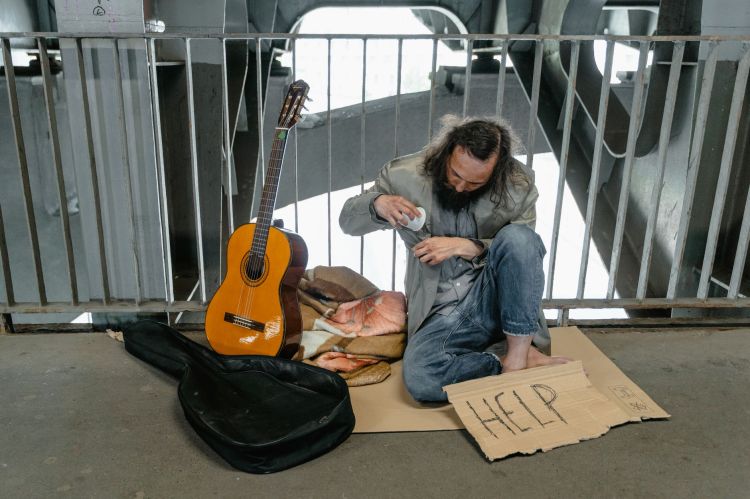
Jesus, as it turns out, comes not as the sovereign king we might expect, but instead appears to us only and always in the need of those around us.
We look to meet Christ in the faces and places of suffering where Jesus, the undercover boss, hides himself most completely.
This story is an invitation for us to embrace a suffering humanity, just as Jesus did.
The point of the parable isn’t to make us feel guilty, but to make us see the importance of what we do here in our earthly journey – the decisions we make, the actions we take, or the words we speak.
I confess that it has been difficult to read this passage over the past several years and not make an immediate connection to the social and economic disparity that this country has been experiencing, especially since the turn of the century.
According to the website, inequality.org, in the United States, the income gap between the rich and everyone else has been growing markedly, by every major statistical measure, for more than 30 years.
Unless we are directly affected, those things often seem pretty small in the larger scheme of life.
Yet Christ cares deeply about them.
He invites us to embrace those in need and those who are hurting in this world.
When the love of God dwells richly within us, we can do that without even realizing that we’ve done it. There is eternal meaning in the most insignificant of actions, in every moment of our lives.
Christ works within us, using us, guiding us, directing us, enlightening the eyes of our hearts, so that he can joyfully proclaim to us:
Truly I tell you, just as you did it to one of the least of these brothers and sisters of mine, you did it to me. [Matthew 25:40]
And we pray:
Almighty and most merciful God, we remember before you all poor and neglected persons whom it would be easy for us to forget: the homeless and the destitute, the old and the sick, and all who have none to care for them. Help us to heal those who are broken in body or spirit, and to turn their sorrow
into joy. Grant this, Father, for the love of your Son, who for our sake became poor, Jesus Christ our Lord. Amen.
(Book of Common Prayer, p. 826)

